Freelancing
Customer Value Proposition: A Freelancer’s Guide
A customer value proposition helps freelancers explain who they serve, what outcomes they deliver, and why clients should choose them. Learn six practical steps to craft a compelling statement, stand out from competitors, and attract better opportunities.
Sanif Sultan
October 16, 2026 · 6 min read

A customer value proposition is the specific reason a buyer chooses you instead of the next option (including doing nothing). It is not a slogan. It is a concise statement that names who you help, the outcome they get, and how you deliver it.
Most freelancers and service providers default to describing their process or listing skills. That forces the client to do the translation work. A clear CVP does the translation for them.
Why a sharp CVP changes the conversation
Buyers who feel understood are more likely to move forward. Research cited by Salesforce shows 86% of business buyers say they are more likely to buy when their goals are understood, yet a majority say most sellers do not take the time to do this. For freelancers the effect is practical: fewer price objections, shorter sales cycles, and higher willingness to pay for expertise instead of hours.
When you can state the outcome in the client’s language, proposals stop feeling like quotes and start feeling like risk reduction. This is also how you strengthen the reputation that leads to better work. People remember specialists who solve a recognizable problem; see how to build a personal brand that people actually remember for the longer view on making that reputation visible.
The three elements that actually hold
Effective propositions usually rest on a combination of these:
- Operational excellence — reliable delivery, clear timelines, predictable process. Example: a freelance developer who ships production-ready code with a written handoff checklist every Friday, so the client’s engineering team never wonders what is ready.
- Product leadership — a distinct method, tool, or approach that produces better results. Example: a conversion copywriter who runs a two-day messaging audit before writing any page, instead of starting from a blank brief.
- Customer intimacy — deep knowledge of the buyer’s specific constraints. Example: a fractional CMO who only works with B2B SaaS companies between $3M and $15M ARR because that is where the onboarding and expansion problems look similar enough to reuse frameworks.
You do not need to lead with all three every time. Pick the one that is hardest for a competent competitor to copy quickly.
Six steps that produce a usable statement
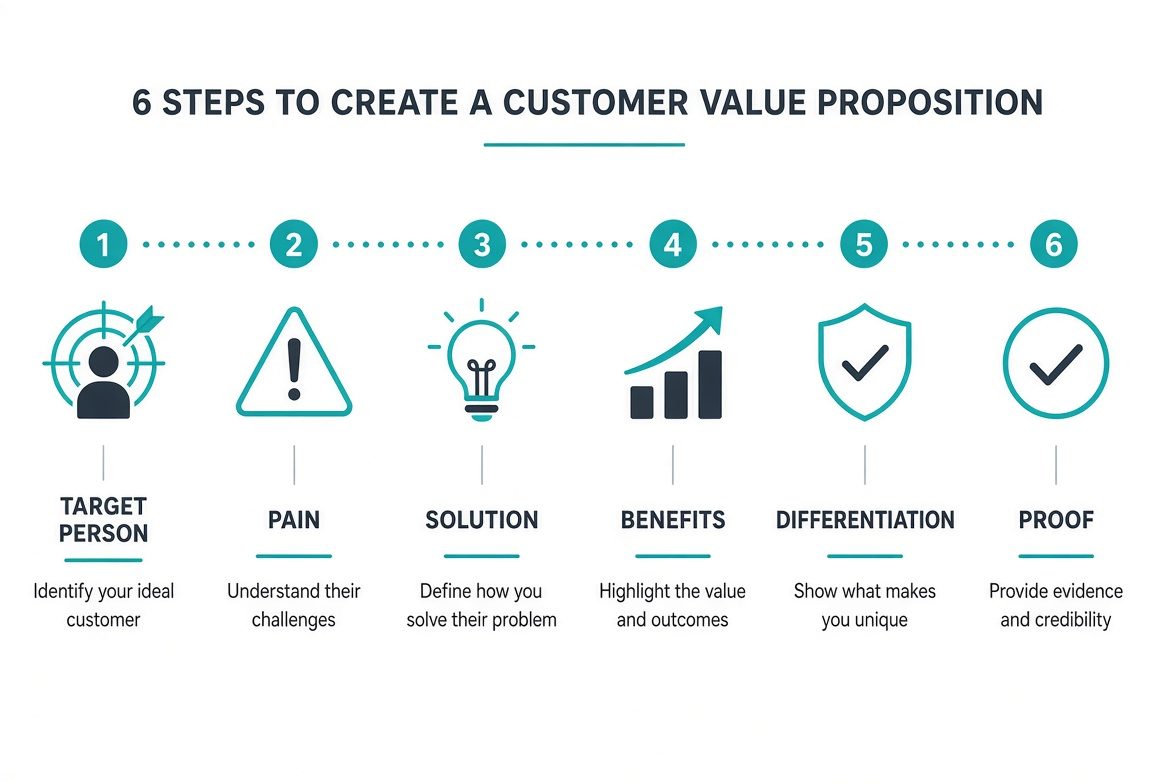
Use Steve Blank’s simple frame as the backbone: "We help [X] do [Y] by doing [Z]". Then pressure-test it with the steps below. Work through one concrete offer and one specific buyer segment at a time.
1. Identify the target customer
Name the role, situation, and constraint. “Busy founders” is too broad. “Series A SaaS founders who are still writing their own onboarding emails and watching trial-to-paid conversion sit under 8%” is usable.
2. Determine the real pain points
Listen for the cost of the status quo. In one case a telecom seller targeting trucking companies discovered that cargo theft at truck stops was the acute problem after the pandemic. Changing the email subject line from generic telecom language to “Find your payloads” lifted open rates from 2–3% to 14–16% and made her the top performer in the country the next quarter. The pain was not “need better connectivity”; it was “losing revenue while the truck is parked.”
3. Describe your solution in outcome language
Explain what changes, not the tools you use. A freelance SEO specialist might say “I rebuild the category pages so organic leads from high-intent searches arrive with the right expectations,” instead of “I do technical SEO and content.”
4. Highlight the benefits that matter most to this buyer
Rank by the metric the buyer already tracks. For the SaaS founder above, the benefit is "more paid conversions from the same traffic" rather than "better-written emails."
5. Stand out from the alternatives
Name the realistic options: another freelancer, an agency, an in-house hire, or the founder continuing to do it themselves. State the difference in terms of speed, risk, or specificity. Per-minute consultations can serve as a low-commitment way for clients to test expertise before committing to a larger project; the economics of that model are covered in why per-minute calls are better than fixed-price gigs.
6. Provide proof
One specific result, a short case note, or a measurable before-and-after beats a list of adjectives. "Cut onboarding email sequence from 11 to 6 messages and raised trial-to-paid conversion from 6.4% to 11.2% in six weeks" is stronger than "proven results".
Once the six pieces are clear, compress them. The ride-share example Salesforce uses—"Reliable rides, built-in safety, fee transparency"—works because it answers safety, predictability, and cost in one line after the longer reasoning is done.
Visual of the process
Worked example: freelance conversion copywriter
- Target: B2B SaaS founders ($1–8M ARR) whose trial users drop off before seeing the core product value.
- Pain: Founders spend evenings rewriting onboarding sequences that still produce single-digit conversion.
- Solution: A fixed two-week messaging sprint that maps the exact moment users abandon and rewrites the sequence around that moment.
- Benefit: Higher percentage of trials that become paid without increasing ad spend.
- Differentiation: The work is scoped to the onboarding sequence only and includes a recorded walkthrough the founder can reuse with their team; most agencies quote a full website redesign.
- Proof: Last three clients averaged a 4.1-point lift in trial-to-paid within 45 days.
Compressed statement: "We help B2B SaaS founders turn more trial users into paying customers by fixing the exact onboarding moments where people drop off, usually in two weeks".
How to put the statement to work
Keep the language at roughly an eighth-grade reading level. Use the buyer’s words, not industry jargon. Place the short version where people actually decide: your Sfeerze profile headline, the first line of skill-feed posts, proposal openers, and the subject line of outreach.
Consistency matters more than perfect wording. When the same outcome appears in your posts, proposals, and calls, clients stop re-explaining the problem and start asking how soon you can start. For practical ways to turn that clarity into paid work, review 15 ways to monetize your skills in 2026 and the client-acquisition tactics in 12 ways to find legit freelance clients online.
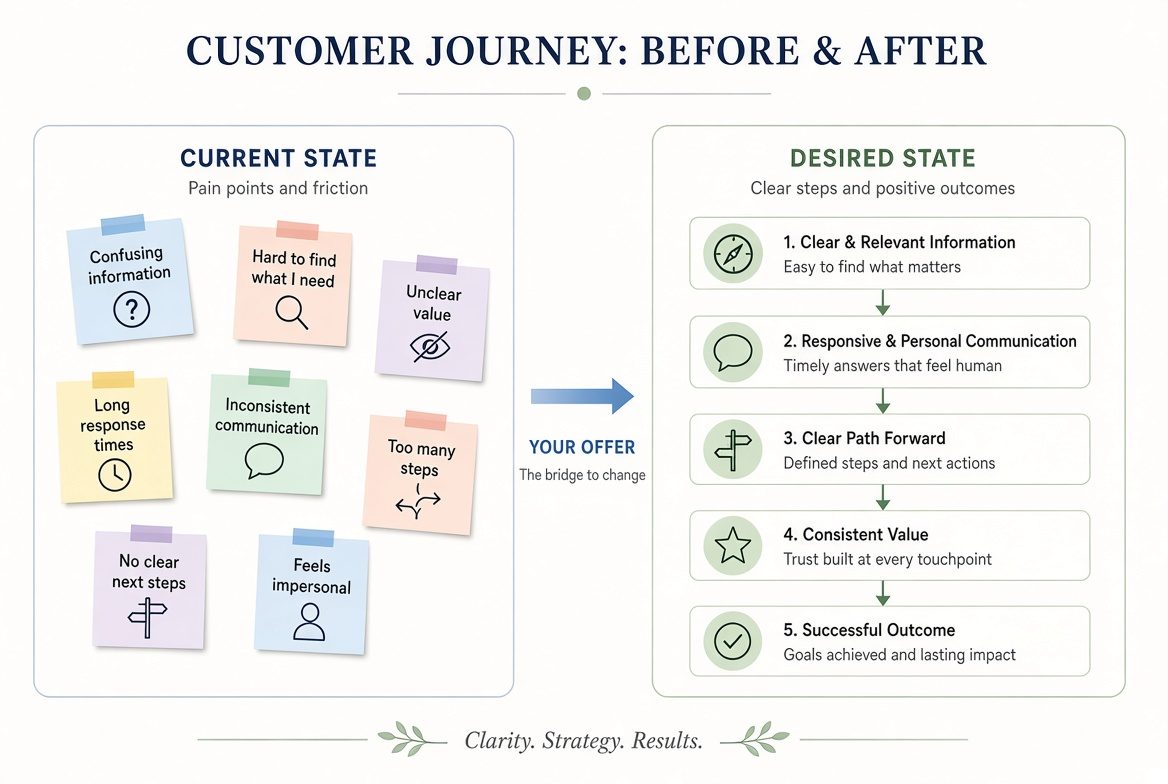
Pain-to-outcome map visual
A strong customer value proposition is short because the hard work happened before the sentence was written. Do the research on one segment, write the six pieces, then compress. The freelancers who can state the outcome in the client’s language stop competing only on price and start being hired for the result.