Career & Work
Legit Work-From-Home Income That Is Not a Job Application
"Legit work from home jobs" mostly leads to flooded listings and scams. If you already have a skill, skip the application: publish proof, set a per-minute rate, and get paid for calls or escrow projects instead of waiting on a recruiter.
Sanif Sultan
October 6, 2026 · 5 min read

Most people typing "legit work from home jobs" are not looking for another career page. They want income they can start without a commute, a fake recruiter, or a three-week application that goes nowhere.
That search is also where a lot of the fraud now lives. The safer path for someone who already designs, writes, codes, markets, or advises is not a better job listing. It is selling the work you can already do: a short paid call when someone needs a decision, and a scoped project when they need a deliverable.
The listing is often the product
Job boards are built to collect applications. That model is fine if you want a W-2 role at a known employer. It is a poor fit if the thing you are selling is judgment.
"Remote data entry", "product reviewer", and "online assessor" posts keep ranking because the words match what people type. Many of them are not jobs. In 2024, consumers reported $750.6 million in losses to business and job opportunity scams, nearly $250 million more than the year before, according to the Federal Trade Commission’s 2024 fraud data. Inside that category, losses to job and employment agency scams rose from $90 million in 2020 to $501 million in 2024, and the number of reports tripled.
A large share of the newer attacks do not even start on a job site. The FTC reported $470 million in losses to text-message scams in 2024, five times the 2020 figure, and named phony job offers — including "task scams" that pay small amounts, then ask you to deposit money to unlock earnings — as one of the top patterns in its 2024 text-scam spotlight.
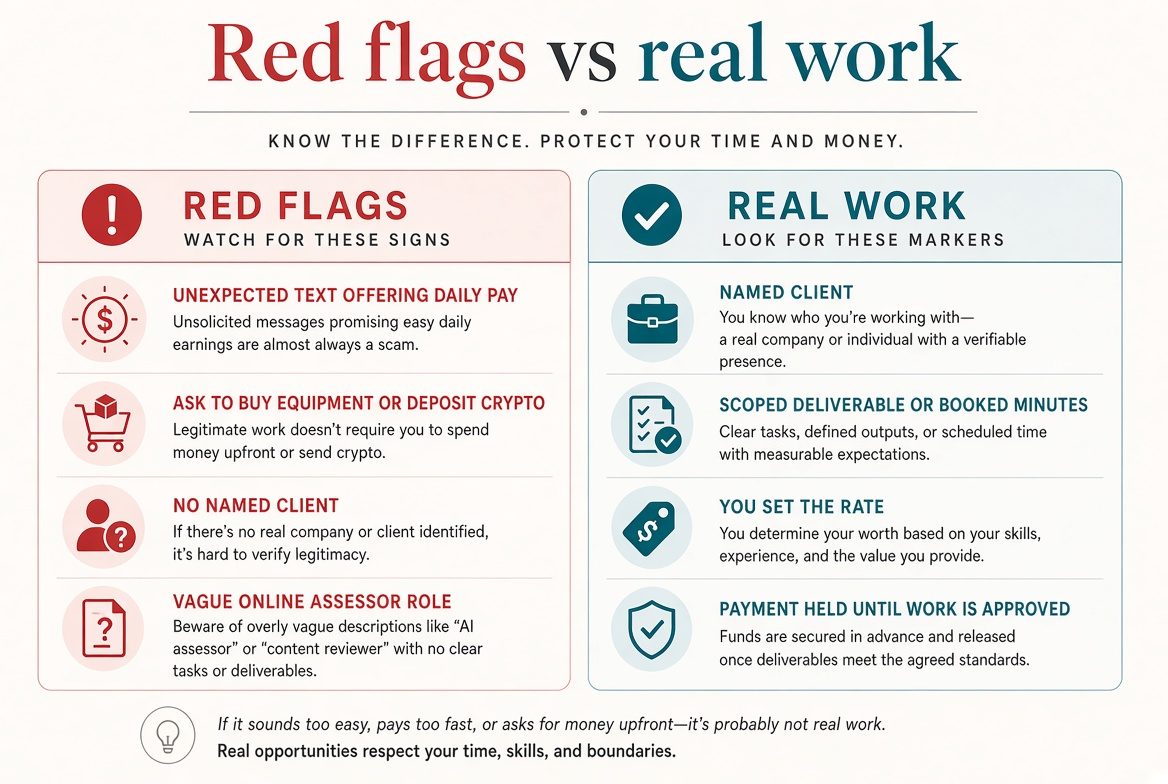
If a stranger promises $200 to $500 a day for rating apps, the offer is the bait. Real clients do not pay you to pay them.
What people actually want when they search those terms
The demand behind the keywords is real. People want hours they control, especially parents and anyone already doing skilled work who cannot add a second commute.
Remote work itself is no longer niche. Bureau of Labor Statistics telework data show that about 34 percent of U.S. wage and salary workers, roughly 51 million people, worked from home at least occasionally in 2024–25, as summarized from the BLS telework series. That figure is employment. It does not include the separate group selling services on their own.
That second group is large. Upwork’s Future Workforce Index found that 28 percent of U.S. knowledge workers — more than 20 million people — freelanced or worked independently, generating $1.5 trillion in earnings in 2024. Those who earned only through freelance work reported a median income of $85,000, compared with $80,000 for full-time employees in the same study, per the Upwork Research Institute release.
The useful split is this: a remote job is still a job. Someone else sets the hours, the tools, and the pay. Work-from-home income from a skill is a sale. You set the rate, the client buys time or a deliverable, and you stop when the work is done.
Three filters before you apply to anything
Use these before you send a resume, a portfolio, or a bank login.
- Who is the buyer? A real client has a name, a company or a profile, and a reason they need you. "HR at a global firm" texting from a free email is not a buyer.
- What are you delivering? A logo critique, a landing-page review, a 10-page edit, a campaign audit. "Complete tasks in our portal" is not a deliverable.
- Which way does the money move? You get paid for work. You do not buy a starter kit, pay a platform fee to withdraw earnings, or send crypto to "verify" a wallet. The FTC’s task-scam pattern is exactly that reversal: small payouts first, then a request that you deposit your own money.
If an offer fails any of the three, close it. Searching harder on the same job board will not fix the model.
Sell the hour you already have
People with a craft waste months applying for "flexible remote roles" that are either flooded or fake. The faster offer is the one clients already pay for.
- A designer does not need a data-entry listing to earn from home. A founder will pay for 15 minutes on a logo direction.
- A developer does not need an "online assessor" role. A founder stuck on a bug will pay for the minutes it takes to unblock it.
- A marketer or editor does not need a product-review gig. A client will pay for a teardown or a scoped rewrite.

That is the difference between an application and an offer. An application asks someone to hire you into a seat. An offer tells them what you will do, what it costs, and how they pay.
On Sfeerze that split is built in. The skill feed is the storefront: posts of work, not a buried portfolio. Expert calls are Zoom sessions billed by the minute, so a client can buy a review without opening a month-long contract. Jobs use a funded wallet and escrow, so a fixed project is paid when the work is approved. Clients pay no platform fee. Experts pay a flat fee only on completed earnings, not to apply.
Two earlier pieces cover the adjacent steps. How to set your freelance rate in 2026 is the pricing floor so a per-minute call does not undercut a project. 12 ways to find legit freelance clients online covers where real buyers actually come from once you stop treating job boards as the only door. If the goal is more than one stream, what a portfolio career is is the longer frame: employment plus calls plus projects, instead of one employer.
Sfeerze · free to start
Stop applying. Publish an offer.
Set a per-minute rate, post proof on your skill feed, and take escrow jobs. Clients book the minutes they need. You get paid for the work, not the application.
A practical week, not a funnel
Skip the course. Do this.
Day 1. Write one sentence: who you help, and what changes after they talk to you. "I review early-stage brand marks for founders who are about to print." Not "passionate creative professional."
Day 2. Set a per-minute rate from the floor in the rate guide, not from what a job ad claims per hour. A 20-minute call should be worth your time after tax and tools. Publish three proof posts: a before/after, a short opinion, a result with numbers if you have them.
Day 3. Tell ten people who already know the work — former clients, colleagues, a niche community — that they can book minutes for a review or hire a scoped job with escrow. Do not buy a list.
Day 4–5. Take one call or one small job. Deliver it cleanly. Ask for a specific follow-up: another review, or the full project. One paid conversation teaches more about pricing than twenty applications.
Income will be uneven at the start. That is the trade for not waiting on a recruiter. The point of the model is that the next dollar does not require another application.
Who this is not for
This is a bad fit if you need a steady paycheck, benefits, and a manager this month. Apply to real employers and ignore anyone who contacts you first with a vague remote role.
It is a good fit if you already have a skill clients ask about, you are tired of listings that ask for a fee or a Social Security number up front, and you would rather be paid for minutes and approved work than for "completing tasks."
The search term will keep saying "jobs". The income, if you have a craft, usually starts when you stop applying and publish an offer.
Start with a profile, a rate, and one proof post on Sfeerze. Skill in. Income out.